

How Coloring Helps Child Development: 5 Surprising Facts
Coloring is not just a fun activity: it is also a powerful tool that supports a child’s development. Below are five scientific facts demonstrating how this simple activity can positively impact various aspects of early childhood growth.
CHILD DEVELOPMENT
@timbiu
2 min read

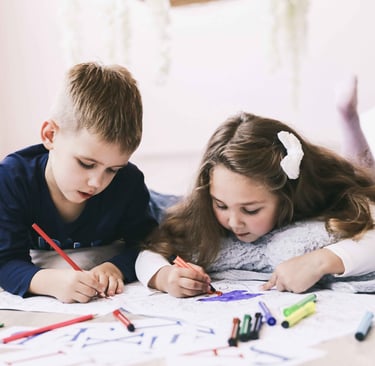
1. Development of Fine Motor Skills
Coloring engages hand and finger muscles, helping refine precise movements necessary for learning to write.
A child practices gripping a writing tool, which aids in later learning to write letters.
Studies have shown that children who color frequently develop better graphomotor skills, making it easier for them to learn handwriting.
2. Improved Concentration and Attention
Children learn to focus on a single task for extended periods.
Coloring requires precision and planning, which supports learning in math and reading.
Regular engagement in such activities can improve attention span by up to 30% in preschool-aged children.
3. Creativity Stimulation
Choosing and combining colors enhances a child's imagination.
Children who color regularly are more likely to develop abstract thinking skills.
In child psychology, coloring is used as a form of emotional expression—children can convey their feelings through colors.
4. Development of Social Skills
Coloring in groups teaches children cooperation, sharing crayons, and collaborative creation.
Studies show that children engaged in creative activities are more likely to form positive relationships with peers.
Coloring in pairs helps develop communication skills and the ability to share workspace.
5. Stress and Anxiety Reduction
Coloring has a calming effect and helps children cope with difficult emotions.
A study in the U.S. found that children who colored before tests experienced lower stress levels than those who did not engage in any artistic activities.
Adults also use coloring as a relaxation tool—the popularity of adult coloring books proves how powerful this activity is.
Skill Development Through Coloring
Fine Motor Precision
Before starting: 60%
After 6 months of regular coloring: 85%
Attention Span
Before starting: about 10 minutes
After 6 months: about 20 minutes
Creativity Level
Before starting: medium
After 6 months: high
Social Skills
Before starting: low
After 6 months: moderate
Stress Level
Before starting: high
After 6 months: low
Note:
Some percentage-based improvements (e.g., attention span increase or skill progression over six months) are illustrative summaries based on general trends observed in developmental research. Actual outcomes may vary depending on the child, frequency of practice, and learning environment.
Institutional Sources of Inspiration: American Occupational Therapy Association, National Institutes of Health, Harvard University Center on the Developing Child, American Academy of Pediatrics, University of Cambridge, UNICEF, Mayo Clinic, American Art Therapy Association.
Disclaimer
The information in this blog post is for general information and learning only. It is not professional medical, psychological, or legal advice. We prepare content carefully and base it on reputable sources, but we cannot guarantee it is complete or perfectly accurate.
You are responsible for how you use the ideas and suggestions in this post.
The author and website are not liable for any losses, damages, or other consequences that may result from using this content.
This is not a substitute for professional help. If you have concerns about a child’s emotional, developmental, or behavioral needs, please consult a qualified professional (for example, a pediatrician, child psychologist, or licensed therapist).
Source: photo freepik
Share
Walk gently. Walk together.


TIMBIU™
Strength, gently held.
© 2026 TIMBIU™. All rights reserved. All characters, illustrations and texts are protected by copyright.